Turning “The Pitt” into My Comfort Show: The Allure of Procedural TV
Hi all, it’s another bad mental week, so I’m stalling on writing on the book. Lots of progress there, but since we’re stalling, here’s some thoughts about television to tide us over.
—
Television is one of my great daily comforts, or well, it used to be when I had time to watch it on a regular basis (i.e., before the birth of my daughter). We’ve switched eating in front of the television to eating as a family, which is great and ensures that our little one is able to get the nutrients she needs to grow up healthy and strong. I am missing out on a lot of premium television, however.
In the scant hours I do have to watch television, I find myself exhausted. Whether it be from the deluge of mind-freaking (sorry Criss Angel) news on a daily basis or yet another personal problem cropping up to stop my creative flow in its tracks (sorry writing projects), it is hard to invest the time and energy into consuming a new television show. Instead, I find myself falling back into shows I’ve already watched and letting the familiarity wash over me while my brain takes a respite, however brief it might be.
I’ve not been one in the past to rely on a “comfort” show, but here I am watching the first season of The Pitt for a third time, wondering, how did I get here?
Shows, Revisited
This isn’t to say I have never rewatched a show before; I’m not suggesting that in the slightest. There are a few shows that I have experienced in my life that have left such a lasting impression that call me to reexperience them in their fullness on a semi-occasional basis. Scrubs and Bojack Horseman are two drama-adjacent comedies that I find myself rewatching from time to time. The sketch comedy ventures of I Think You Should Leave with Tim Robinson and Aunty Donna’s Big Ole House of Fun are also two quick watches that I revisit.

Bojack Horseman, pictured here sneezing on Marisa Tomei at a Christmas party.
However, these are more subjects of study than they are pleasurable mind-numbing treatments. I love studying these shows to figure out how they tick or how to replicate some of the more powerful feelings they provoke. I’m more watchmaker than watchlooker, if you catch my drift.
Dissecting why something works can be a fun exercise in learning the tools of the trade, but it is energy hungry work and doesn’t suit the sort of parameters one might describe as a Comfort Show.
The Office is one such often cited comfort show, a sitcom based in an office with off the wall characters who start out relatable, but ultimately end up versions of themselves who very few would tolerate in the workplace. I’ve heard of people who rewatch other sitcoms like Friends for those who grew up in the 90’s or in my dad’s case Seinfeld, to the point where he can more recite the episode than watch it.
Then we have the genre of television that is almost engineered to be a rewatchable show that brings the viewer comfort. Not in the form of mind-numbing or sheer enjoyability, but in the form of always providing an answer to the problems encountered during its runtime. Comfort in the form of there always being a solution. Comfort in the form of a reality where things always work out in the end.
I speak, of course, of the procedural drama.
Drama, Procedural’d
Medical procedurals, crime procedurals, law procedurals, it matters not. All of these genres operate in the same fashion. A problem is introduced in the cold open that leads to the introduction of our long established protagonists. Those protagonists bring in their episodic issues that are explored in-between the solving of the major problem, which is complicated and twisted throughout the middle. All of which leads up to a nice packaged solution that brings the case to a close while furthering the interpersonal dramas of the cast involved in solving the case. Every single episode (minus pilots, sweeps week, and finales, which all build on an ever-growing arc of a story that may or may not be the real focus of the show) plays out in this manner..
Entries in this category are your classic Grey’s Anatomy, CSI, NYPD Blue, any of the 9-1-1 shows, etc., and they are all various levels of success in their related genre or sub-genre as evident by their many, many, many seasons.
The appeal is very easy to understand. Humans love puzzles. Our brains are wired to try to solve puzzles. Puzzle solving is also very energy intensive, however, but the feeling of solving a puzzle can be easily triggered through these shows. Somewhere down the line, the creators of these shows and stories figured out that by presenting a mystery, showing how one might solve said mystery, and the unraveling of the mystery by some other party can trigger the same feelings of having solved the mystery oneself. Agatha Christie made a living in this manner. Arthur C. Doyle did as well. It’s no wonder that some of the earliest examples of serialized works just so happen to be mystery novels. There’s something in the puzzle of it all.
These works also have an appeal in that they contain the answer to the mysteries they pose. Unlike real life, the answer exists and is worked out given that the work is published. Dangling a mystery in front of an audience is not the difficult part. Providing the answer is, especially if the answer is satisfying and doesn’t raise further questions.
This stands in the face of real life where the daily puzzles and mysteries we face have no prewritten answer for us to discover at the end of the episode. Sudden illnesses, murders, and other such topics explored in these shows can sometimes just happen for no reason at all, which is rather unsatisfying.
According to Project Cold Case, an organization involved advocating for families involved in unsolved crimes, from 1965 to 2023 there were 1,031,942 homicides in the United States of America. 685,669 of those homicides were solved meaning there is a 66.44% clearance rate for murder in the U.S. during this time period. So for a shocking 34.56% of families related to homicide victims, there still is no answer long after their “episode,” that is the period when the crime immediately impacted their life much as it would in a television show, ended.
On the other hand, it can be very hard to find answers in the medical field. People sometimes bounce from specialist to specialist trying to nail down what exactly is wrong with them. There are conditions out there that medical experts still dispute and argue over to this day with Chronic Lyme Disease being just one I can name off the top of my head. “Leaky Gut Syndrome” is another, and beyond that, various slices of the population in certain demographics struggle with getting medical professionals to take their pain seriously enough to nail down a diagnosis.
While there are no official statistics for how many people die from conditions that are only diagnosed posthumously, the John Hopkins Armstrong Institute Center for Diagnostic Excellence estimates that approximately 795,000 Americans die or are permanently disabled each year due to diagnostic errors from a study conducted in 2023. For these people, there might have been the feeling of finally having an answer, but it was the wrong one, and the wrong answer can be just as unsatisfying as the correct one.
Real life doesn’t quite measure up to procedural television when it comes to a satisfying ending and of course it doesn’t. The continuation of real life does not hinge upon audience ratings. Our experiences being satisfactory does not necessitate its ending. To put it simply, life goes on. Television shows don’t always.
House, M.D.’d
To get personal for a minute, in April of 2024, my sister suffered from a stroke and from complications of the treatment of that stroke suffered a double bowel rupture that landed her in the hospital for 41 days. She has since made a full recovery and is back to living a normal life, but for the rest of that year and most of 2025, my family lived in a state of not having the answers. We still, in fact, do not have the answers as to what exactly went wrong.
During this time, I found myself wishing for some larger than life character to swoop in and provide us with the solace that comes with knowledge. Not in a “is everything going to be okay,” way, but in a “this caused the stroke, and we can treat it by doing this” way. This hunger for answers led me down the road of seeking out solace from false prophets: fake television doctors.
And one such doctor provided some very much needed solace in the form of continuously providing answers to the most difficult medical cases of his day. That doctor is none other than Dr. Gregory House of the show House, M.D., a Sherlockian archetype hobbled by his personal addictions to fight his demons while wisecracking and insulting his way to the answers to the case-of-the-week every time. (Save for the few times that he does, in fact, not find the answer, as the show liked to do from time to time).

Get it? Cause he’s a doctor.
For those who have not watched House, M.D., it is a revelation to the medical procedural drama in that the cases are not always the focus. Experimental at times in style and substance with medical problems and solutions that rival even the most outlandish fantasies of medical writing, House, M.D. is a procedural on its own level of quality. And for moments when you are in the darkest modes of thinking, House can provide you with the hope that somewhere out there is a cranky drug addict doctor who might just have all the answers.
I rewatched all 117 episodes of the eight seasons of the show over the course of 2025. There was solace there. And my sister got better. I’d like to think these things are related, but to suggest so would be magical thinking and verge on being delusional, so I won’t.
Point is, I get the allure of a medical procedural. I get the allure of seeking out media that always provides an answer. It is a drug unlike anything else. A dark genie that promises everything while delivering nothing. And in that way, I think procedural dramas can be very, very damaging to one’s psyche and warp one’s sense of reality. If all you consume is media where the answers are found every time, you start to think that’s how the world works and from the statistics I quoted in the earlier section, it’s simply not.
Pitt, The’d
Enter The Pitt. My new comfort show, apparently. The Pitt is a quasi-medical procedural in that one season is a single shift at an emergency room of a hospital. Every episode is the subsequent hour of that shift. A single hour may have several different cases presented and solved in a satisfying, real-to-life pacing. Oh, did I say solved? That’s a misspeak. Cause they don’t always solve the case. Sometimes, the person just dies and the diagnosis comes posthumously. There’s always an answer, but it’s not always in time. Sometimes, the answer is simply “it was their time.”
The Pitt has become my comfort show not because of the cases and the procedures to those solutions. It’s not about how satisfying the solutions are. It’s become my comfort show because of the characters, how these doctors and nurses never stop trying to provide health care to their charges. There’s some fun dialogue and playful exchanges peppered here and there, but the real draw of the show for me is the unrelenting pacing of everything.
I’m not going to spoil the first season of the show and I’ll ask you not to spoil the second season currently airing, as I’m waiting for the whole season to be out so I can devour it all at once before inevitably rewatching it. That makes discussing it vis a vis the purpose of this article a bit difficult, but I think the most satisfying thing about the show for me is that there isn’t always an answer. It’s more lifelike in that regard and given the structure and nature of how the show creators are telling this story through the lens of a single shift, there are questions we will never get the answer to as the next season will be somewhere in the future to nurture character growth and present new problems.
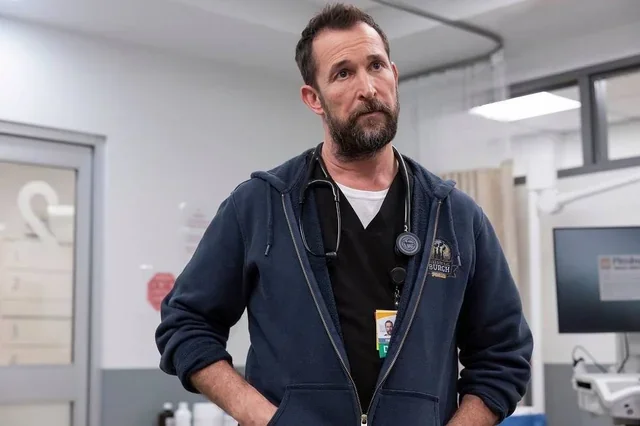
This guy sometimes sounds exactly like Nathan Fillion and it scares me.
I very much enjoy that the show does not coddle me in that regard, unlike a House, M.D., for instance. The media we consume, the words we read, the words we say and use, all of it shapes how we perceive the world and I think it’s important to challenge that perception from time to time to foster growth.
The Pitt challenged my perception of medical procedurals being “soft” on critical thinking by dulling the world through always providing an easy to digest answer by the end of the episode and gave me a glimpse of what it’s like to work in an emergency room. The show, through events that happen later in the season, promoted a huge push for people to donate blood.
We need more media that provokes real world change and challenges people’s perceptions of the world. For now, I’ll find comfort in this one new show that does that for me while keeping an eye out for the next one.
Or something.